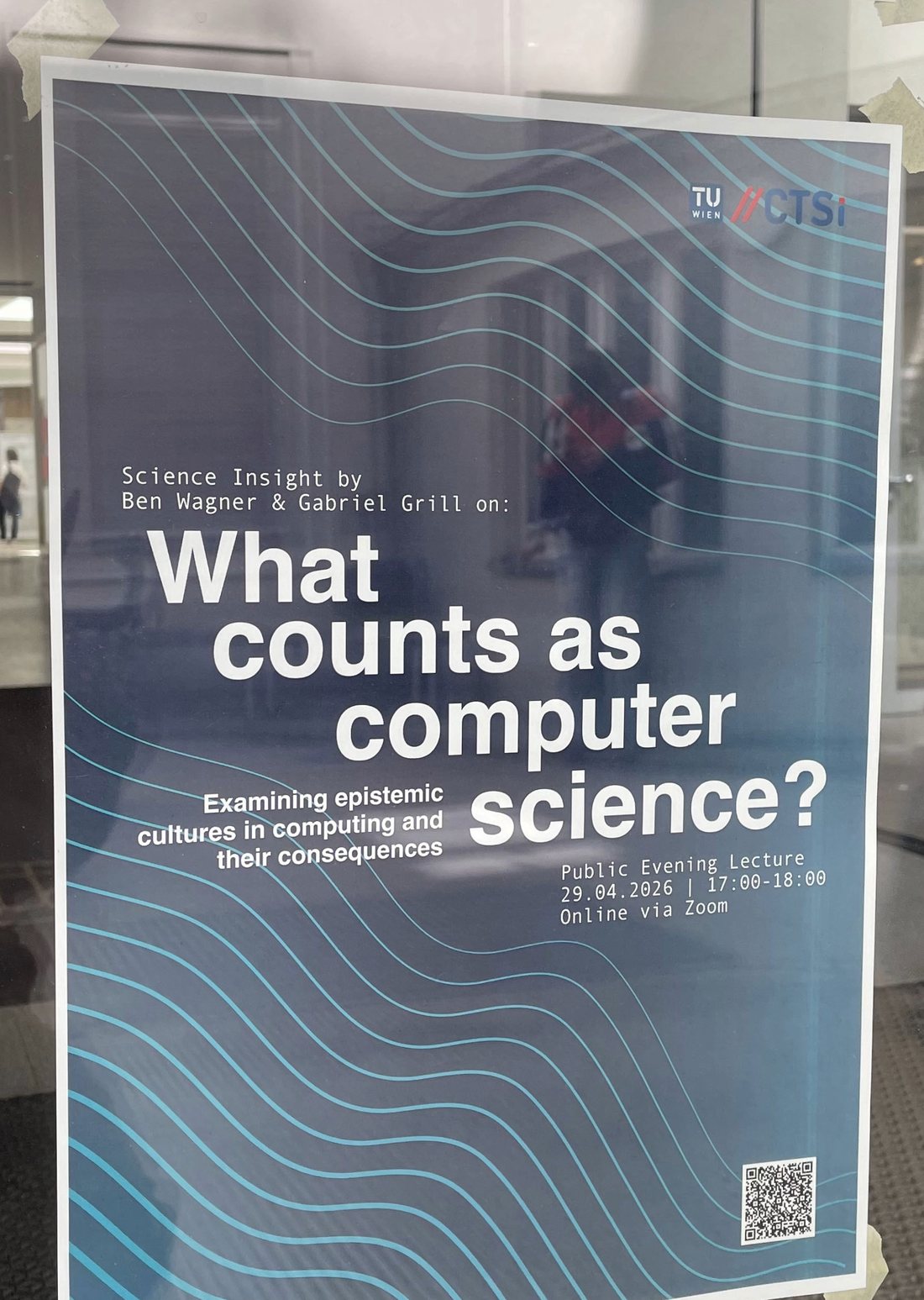
On April 29, 2026, the CTSi//circle.responsibleComputing hosted its first Public Evening Lecture as part of the new Science Insight series of the Responsible Tech & Society Forum. Under the title “What counts as computer science? Examining epistemic cultures in computing and their consequences” Univ.-Prof. Dr. Ben Wagner and PhD Gabriel Grill discussed the historically shaped epistemic cultures of computer science and their societal implications.
The event brought together stimulating perspectives from research and practice and encouraged critical reflection on the role of computer science in both society and academia. The session was moderated by Noah Pfander (CTSi).
A recording of the event is available on YouTube.
About the talk
What actually counts as computer science, and who gets to decide? Ben Wagner and Gabriel Grill approached this question by describing computer science as an epistemic culture, that is, as a system of knowledge with specific practices and criteria for what is considered legitimate and valid knowledge. They showed that the discipline has historically oscillated between different self-conceptions. Computer science emerges simultaneously as a formal foundational science, an engineering discipline, and a driving force behind developments in the cognitive sciences. These competing perspectives continue to shape the field today, influencing which research questions are seen as relevant and which methods are considered appropriate.
A central focus of the talk was the concept of solutionism, understood as the recurring assumption that technological innovation can fundamentally solve societal problems. This idea runs throughout the history of computer science, from early developments such as the General Problem Solver in 1957 to contemporary promises surrounding artificial intelligence. At the same time, the speakers emphasized that this mindset tends to reduce complex social and political issues to technical problems. Phenomena such as algorithmic bias, disinformation, or structural impacts on labor markets are often framed as purely technical challenges, even though they are deeply embedded in societal contexts.
The frequently proposed solution of strengthening engineering ethics was also critically assessed. The speakers pointed out that ethical education remains insufficiently institutionalized in computer science and is not mandatory in a significant proportion of study programs worldwide. Moreover, empirical evidence shows that even in cases of serious technological failures, clear forms of accountability rarely materialize. As a result, structural issues can only be addressed to a limited extent through approaches focused on individual ethical responsibility.
In conclusion, the talk offered a constructive perspective on the current state of the discipline. Computer science was described as a field characterized by a high degree of epistemic flexibility that continuously expands its boundaries. This adaptability contributes significantly to its societal relevance, while also opening up possibilities for integrating alternative epistemic perspectives. Against this background, Wagner and Grill argued for a more systematic integration of responsibility, accountability, and interdisciplinary approaches. The guiding question they posed was how the epistemic cultures of computer science can be expanded and pluralized in order to meet the complex demands of an increasingly digital society.
About the speakers
Ben Wagner:

Ben Wagner is University Professor of Human Rights and Technology at IT:U, Director of the AI Futures Lab at TU Delft and Professor of Media, Technology and Society at Inholland. His research focuses on the governance of socio-legal systems, freedom of expression online and the regulation of technology. He is also on the advisory board of the data science journal Patterns , the Responsible Technology Institute at Oxford University and the Centre for Democracy & Technology Europe .
Previously, Ben served as founding Director of the Center for Internet & Human Rights at European University Viadrina, Director of the Sustainable Computing Lab at Vienna University of Economics and member of the Advisory Group of the European Union Agency for Network and Information Security (ENISA). He holds a PhD in Political and Social Sciences from European University Institute in Florence.
Gabriel Grill:

Gabriel Grill, PhD, is a researcher on AI and digital sovereignty at the Interdisciplinary Transformation University Austria (IT:U), where he is part of the Human Rights and Technology group, and a visiting researcher at TU Delft. He holds a PhD in Information Science and Science and Technology Studies from the University of Michigan and a Master’s in Logic and Computation from TU Wien. His work on technology policy and impact assessment — covering topics such as the AMS algorithm, social media surveillance, and the false promises of generative AI — has been cited in parliamentary technology assessments across Europe, NGO reports (Human Rights Watch, Epicenter.Works, Coworker.org ), and press outlets including Wired, Futurezone, and Der Standard.
Image credits: © CTSi 2026 (poster), © Complexity Science Hub Vienna 2026 (Ben Wagner), © Tereza Østbø Kuldova 2020 (Gabriel Grill)
Outlook and Recording
The event highlighted that computer science is not merely a technical discipline, but one that remains deeply embedded in social, political, and cultural contexts. At the same time, it underscored the importance of interdisciplinary approaches in addressing the complex challenges of an increasingly digital society. In doing so, the event reflects key objectives of the CTSi, which promotes dialogue between technological innovation and societal responsibility. The discussions on digitalization, accountability, and interdisciplinarity also align with several strategic priorities of TU Wien, particularly the advancement of digital transformation, the promotion of innovative research cultures, and the exchange of knowledge and methods across disciplinary boundaries. By bringing together diverse academic perspectives and encouraging critical reflection on their societal implications, the format contributes to the development of responsible technologies with long-term societal impact. Furthermore, the involvement of internationally renowned researchers strengthened connections with international scientific communities and enhanced the visibility of TU Wien.